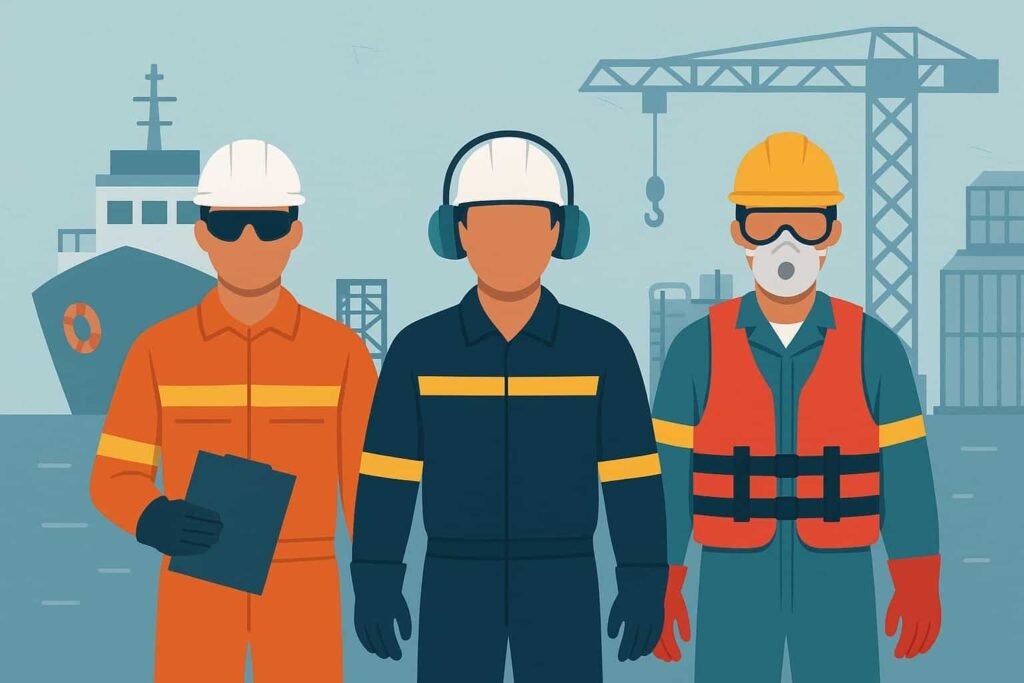
In the maritime industry, ship safety equipment is more than a compliance requirement — it’s the foundation of every safe operation.
Why It Matters:
- The Occupational Safety and Health Standards (OSHS) under Republic Act 11058 requires every worker—whether on deck or in a dry dock—to wear approved PPE.
- Compliance protects your crew, assets, and company reputation during audits by MARINA, DOLE, and RightShip.
Everyday Maritime Scenarios:
⚙️ Dry Dock (Subic) – Workers in confined spaces need full coveralls, helmets, and chemical gloves.
⚓ Bulk Carrier (Batangas) – Crew must wear anti-slip footwear and hearing protection during engine maintenance.
🛟 Tug Operations (Manila Bay) – Life jackets and flame-resistant clothing are mandatory for open-deck work.
Safety Is Tangible:
Nitrile gloves. Welding shields. Marine life vests. Each piece of PPE isn’t just gear — it’s what stands between a safe shift and a serious incident.
1. The Law Behind Your PPE Obligations
In 2018, the Philippines enacted Republic Act No. 11058 or the Occupational Safety and Health Standards Law, which requires all employers — including shipyards, shipping companies, and manning agencies — to provide adequate personal protective equipment at no cost to their workers.
The DOLE Department Order 198-18 enforces this law, specifying that workers exposed to physical, chemical, or biological hazards must receive protection appropriate to their tasks.
For shipyard operations, this means every welder, fitter, oiler, and cleaner must have safety gear that meets industry-recognized standards such as ISO, ASTM, or EN specifications.
Failure to comply can result in administrative penalties, suspension of operations, or disqualification from future contracts. But beyond compliance, adherence builds trust.
Vessel inspectors and charterers take note when safety is visibly prioritized — a key consideration during ISM Code verifications and MARINA flag-state inspections.
➡️ Reference:
2. Tailored Protection for Every Crew Member
Different maritime roles demand different protection. A one-size-fits-all PPE policy doesn’t work when your crew faces drastically different risks across departments.
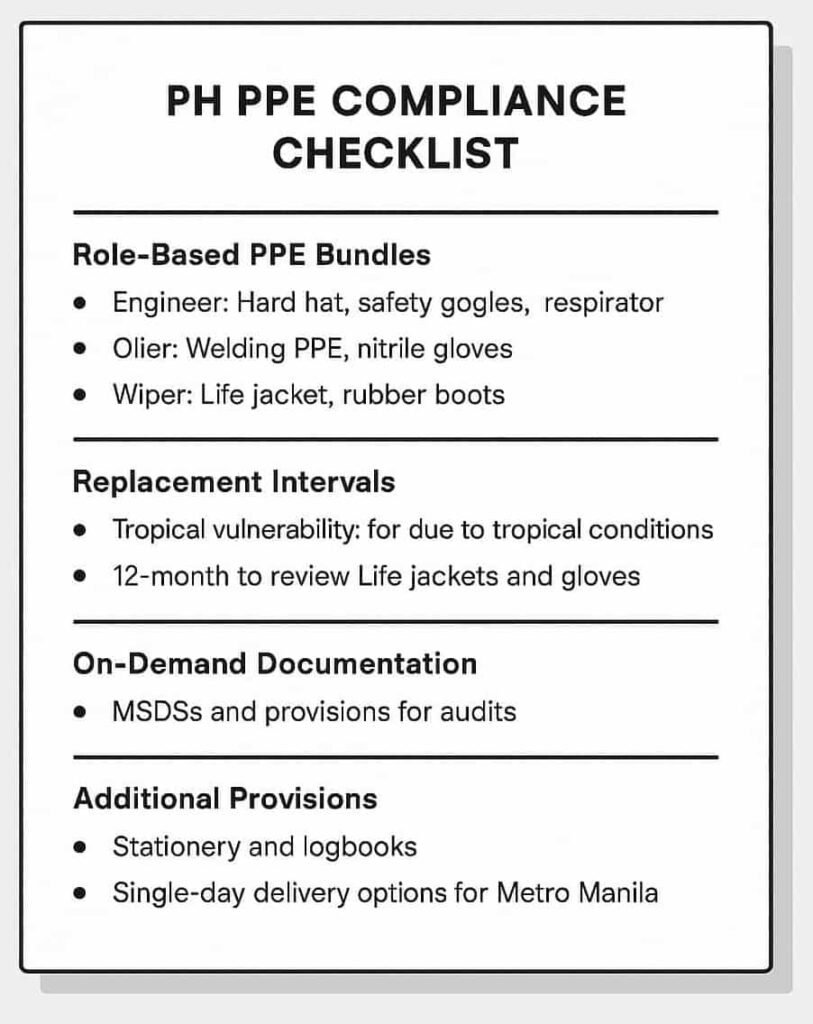
Engineer PPE Kit
Engineers handle heat, oil, and moving machinery. Their PPE kit typically includes:
- Flame-resistant coveralls or welding PPE
- Heat-resistant nitrile gloves
- Safety goggles or face shields
- Steel-toe safety boots with slip resistance
- Ear protection for extended engine-room work
Oiler PPE Kit
Oilers deal with lubrication, spills, and repetitive mechanical exposure. Their essential PPE includes:
- Industrial nitrile gloves
- Chemical-resistant aprons
- Safety footwear
- Ear protection
- Basic face mask or half-mask respirator
Wiper PPE Kit
Wipers handle cleaning and support work across decks and compartments. Their PPE focuses on general protection:
- Basic coverall set
- Cotton or nitrile gloves
- Safety goggles
- Non-slip safety shoes
Shipyards and vessels often request customizable PPE bundles that can be swapped or replenished based on crew turnover.
Many procurement officers also add stationeries and logbooks in the same delivery to streamline documentation and logistics.
3. Built for Tropical Conditions
Philippine shipyards face relentless heat, humidity, and salt exposure — conditions that drastically shorten the lifespan of safety gear.
Unlike temperate climates, the tropics accelerate corrosion, fabric wear, and chemical degradation.
To maintain compliance and protection:
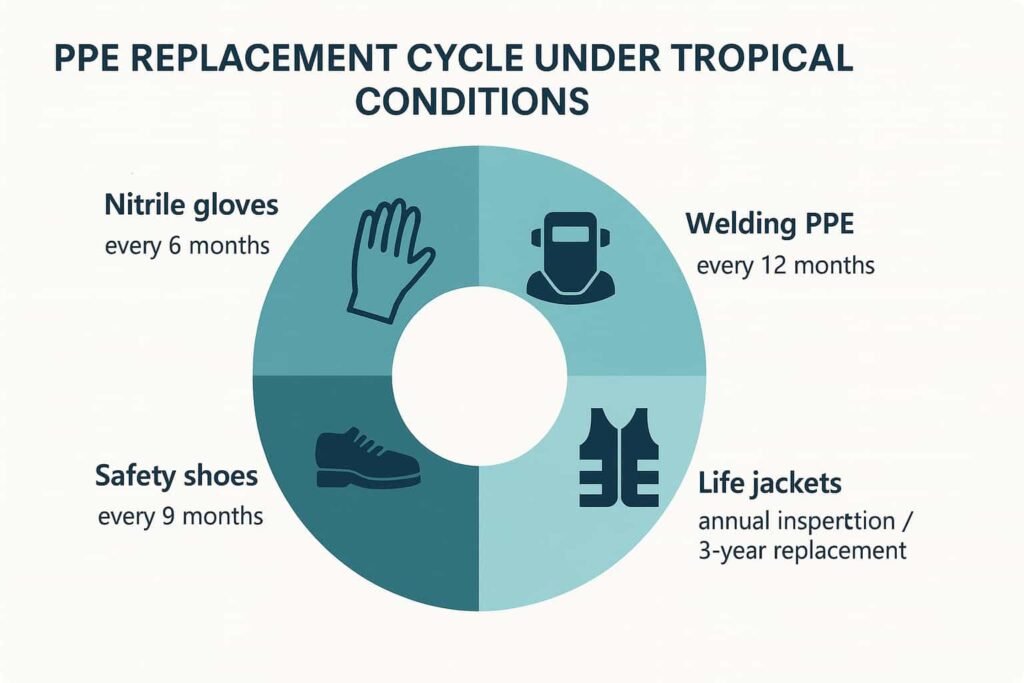
- Inspect PPE quarterly for cracks, tears, and corrosion.
- Replace gloves and coveralls every 6–9 months under tropical working conditions.
- Rotate marine life jackets and immersion suits according to manufacturer guidelines and flag-state requirements.
DOLE and the International Labour Organization (ILO) emphasize that PPE should remain serviceable at all times; once compromised, it must be replaced immediately — not during the next audit.
➡️ Reference:
4. Documentation & Audit Readiness
Compliance doesn’t stop with equipment delivery — it extends to proper documentation.
During MARINA or Third Party inspections, auditors will ask for tangible proof that your PPE meets standards and that your crew has received and used it.
Key documents include:
- PPE Issuance Register (signed by crew)
- Material Safety Data Sheets (MSDS) for chemicals and lubricants
- Certificates of Conformity (COC) for fire and rescue gear
Maintenance Logs for reusable PPE (e.g., harnesses, breathing apparatus)
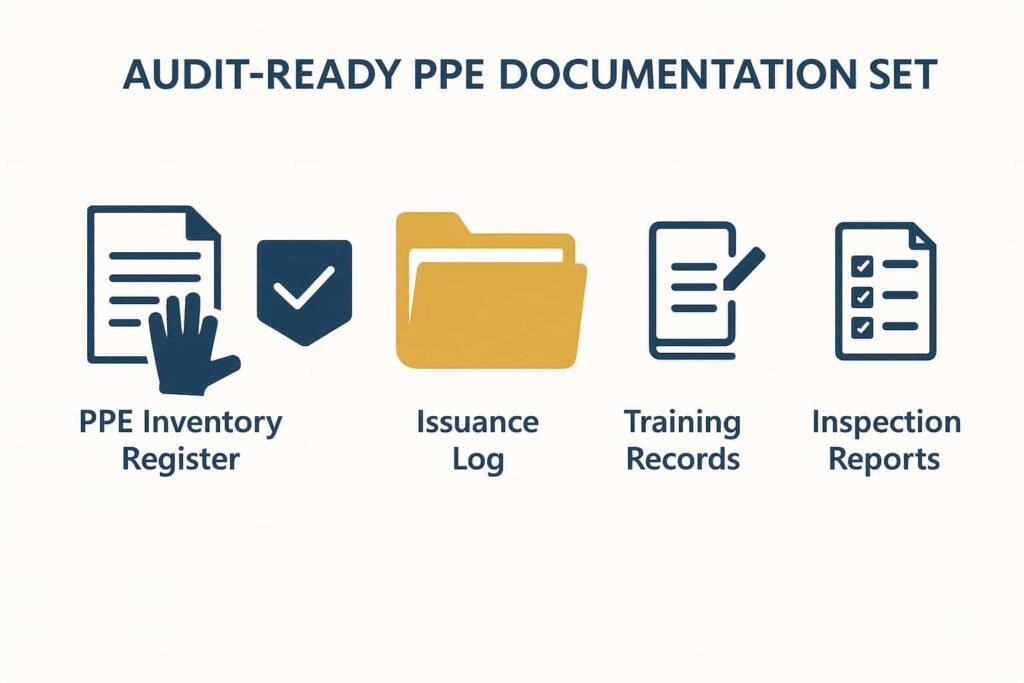
Auditors may also verify whether your ship safety equipment inventory aligns with the Safety Management System (SMS) manual.
Having organized, accessible documentation not only satisfies audit criteria but also reduces downtime when inspectors are onboard.
5. Marine Rescue & Fire Safety Integration
PPE is often discussed separately from maritime fire safety and marine rescue equipment, but in reality, these systems are integrated.
During drills or emergencies, the same personnel responsible for firefighting rely on PPE that meets both industrial and marine standards.
A well-maintained equipment lineup should include:
- Certified marine life jackets and immersion suits
- Fire-retardant coveralls and hoods for engine personnel
- Heat-resistant gloves and respiratory masks
- Rescue lines, helmets, and eye protection compatible with SOLAS requirements
Regular inspections of this combined safety gear ensure that nothing fails when it’s needed most — particularly during RightShip or flag-state audits that verify readiness for emergency response.
6. Delivery Support & Availability
Timely replacement of PPE is crucial for continuous operations.
Procurement delays can cause compliance lapses, especially when vessels operate on tight schedules or unplanned dry-docks.
Chuusin Safety Gears, based in Manila, supplies pre-bundled maritime PPE kits tailored for each role. Delivery bands include:
- Metro Manila: Same-day or next-day delivery (subject to stock)
- Luzon / Visayas / Mindanao: 3–5 business days via accredited couriers
- Special Requests: Custom quantities or brand substitutions
This streamlined system ensures that shipyards and shipping offices can remain compliant without interrupting maintenance cycles or port calls.
7. How to Get a FREE Customize PPE Quote
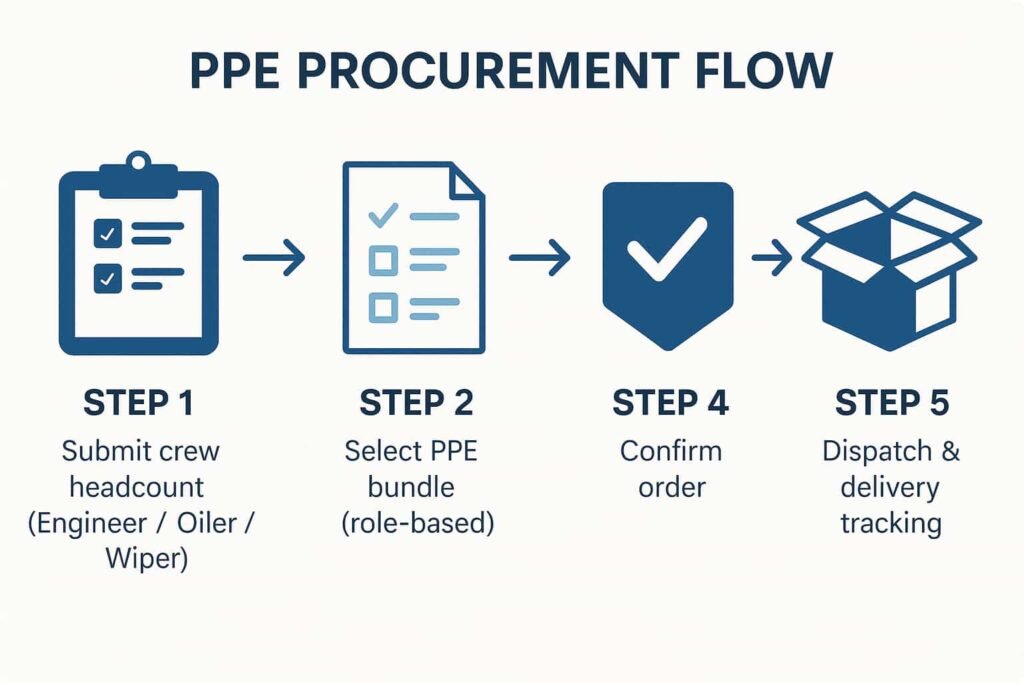
Getting compliant doesn’t have to mean waiting weeks for quotations or delivery.
The Customize PPE quote system allows ship managers to get tailored estimates quickly:
- Submit Crew Headcount – Indicate the number of Engineers, Oilers, and Wipers.
- Select PPE Kit Type – Choose standard or premium bundles based on your operational risks.
- Receive Quote in fast – A detailed breakdown will be sent via email, including optional add-ons (stationery, logbooks, signage).
- Confirm & Deliver – Once approved, dispatch is arranged through your preferred courier or pick-up schedule.
This process removes the guesswork from procurement and ensures compliance without administrative drag.
8. Safety Isn’t Optional — It’s Operational
The difference between a compliant and non-compliant vessel often comes down to preparation.
Investing in reliable ship safety equipment and maritime PPE isn’t an expense — it’s risk control. Auditors, clients, and insurers all look for tangible proof that safety is ingrained in company culture.
By following RA 11058 and maintaining updated PPE inventories, shipyards and vessels in the Philippines can meet audit standards, protect their people, and preserve operational credibility.
PPE quoted fast + free PH PPE compliance checklist — fully aligned with RA 11058, MARINA, and ISM Code expectations.
When it comes to maritime operations, compliance isn’t paperwork. It’s proof of competence.